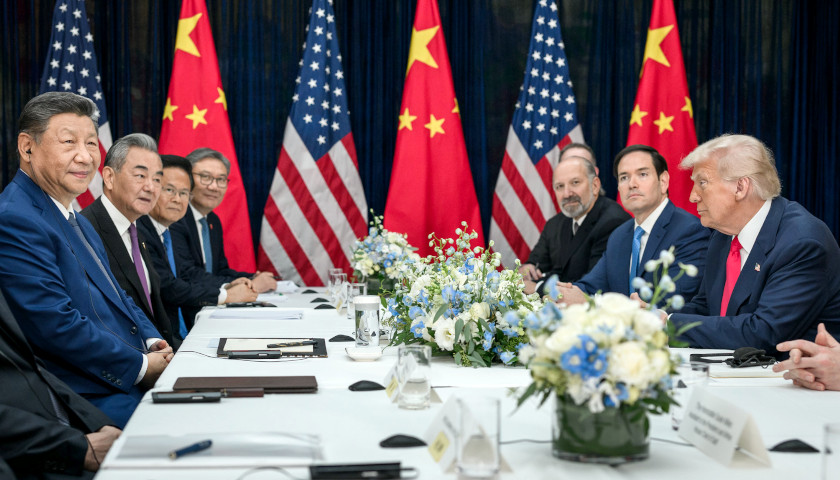
Intelligence community files released by the White House claim that China paid American journalists, social media influencers, and leveraged relationships with American businesses in order to sabotage President Donald Trump during his first term in the White House, with a CIA document claiming the foreign government went as far as to pay journalists to print negative articles.
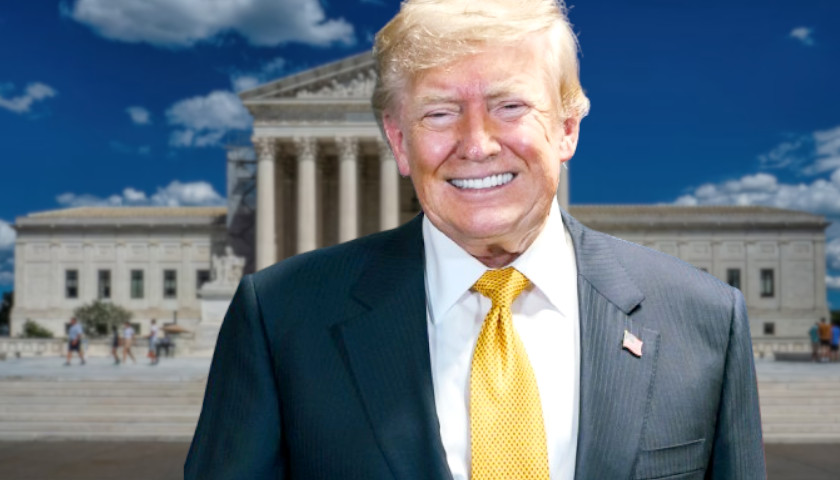
In a Thursday speech delivered to the nation, Trump cited a CIA document that showed the agency determined, beginning in 2019, China “sought to identify U.S. journalists who had reported negatively on the U.S. president and pay them large sums of money to write more negative articles about him,” adding that the adversarial government “wanted the U.S. president to lose the next election.
Trump appeared to quote from one of more than 20 documents showing intelligence community conversations about Chinese interference in American elections, specifically, a CIA document containing reporting by the agency about the efforts and motivations of the Chinese government from 2018 to 2020.
In addition to purportedly seeking to pay journalists in order to smear Trump, the Chinese government also leveraged tariffs on products exported to China from states that voted Republican during the 2016 election and leveraged international business relationships in its efforts to prevent the president from being reelected in 2020.
“As part of this campaign, China was analyzing the 2016 U.S. Presidential elections and identifying U.S. States that voted for the U.S. President,” according to the CIA document. “The Chinese would then identify sectors within these states that voted to support the U.S. president’s political party, and would attempt to make these sectors experience negative financial consequences by levying tariffs on exports to China from those sectors.”
Separately from China’s effort to impose economic hardship on Americans who voted for Trump, the CIA document alleges, “China regularly extended invitations to influential U.S. individuals to travel to China for speaking engagements for which they were paid significant speaking fees, along with first-class travel and accommodations.”
The CIA wrote that this strategy aimed to make Americans influential in politics and business “hooked on China,” and that it was most effective with individuals and groups, including “think tanks, academics, and former U.S. government employees.”
According to the intelligence agency report, “the Chinese relied on hitting these entities in the wallet to force them to talk with the U.S. President about tariffs.”
Other intelligence documents, also released by the White House, appear to suggest China’s efforts to influence American public discourse extend beyond economic matters.
One email exchange, including officials from the National Intelligence Council (NIC) and Office of the Director of National Intelligence (ODNI), included “proposed language” regarding Chinese meddling in American public life by the NIC:
Unidentified pro-China influence actors [redacted] have been spreading English-language videos on US social media platforms that criticize the President’s policies, promote socially divisive themes, and denigrate him, [redacted].”
Three more documents claim the China “developed capabilities to project themes” on an array of topics into both social media outlets, namely TikTok, Facebook, Twitter, and YouTube, but also into “mainstream media,” using “a variety of overt and hidden influencers and media contributors.”
According to the document, “themes” China sought to “project” into American public life using “influencers and media contributors” included advocacy for violent rioting and looting; questions regarding Trump’s ability to govern, legitimacy, and response to COVID-19; racial tensions between white and black Americans; tensions among the U.S. Armed Forces; gun ownership, tensions between migrant communities and the federal government.
More claims about China’s efforts to influence the American public were included in a NIC assessment released by the White House:
China uses mostly enticements and occasionally coercion to extract more pro-China positions and to punish those whom Beijing views as opposed to China’s interests. It also employs disinformation and critical statements attacking the US Government’s handling of the COVID-19 pandemic and other issues, such as the closure of the Houston Consulate, Hong Kong, the legal status of the South China Sea, and China’s efforts to dominate the 5G market. [redacted], a pro-China network of online accounts posted video content critical of President Trump before it was deactivated by social media platforms; [redacted] We assess Beijing probably calculates that a concerted effort to [redacted] influence the Presidential election would [redacted] backfiring and offer uncertain benefit, but [redacted] also recognizes [redacted] critical statements might affect the race.”
The White House also produced evidence claiming the Chinese government obtained voter files of about 220 million Americans, while Russia and Iran also sought to influence the election.
Trump also said the U.S. Department of Homeland Security (DHS) determined nearly 300,000 non-citizens are on voter rolls in 30 states, and said the FBI found evidence Democrats fabricated fake votes in Michigan in 2020.
– – –
Tom Pappert is a 2025 recipient of the Dao Prize and the lead reporter for The Tennessee Star. He also reports for the Star News Network. Follow Tom on X. Email tips to [email protected].