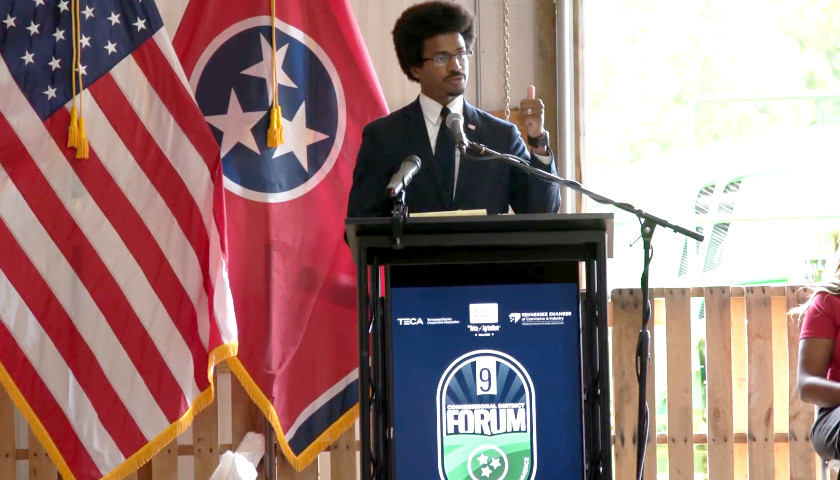
Six of the 10 candidates who have qualified for the primary election ballot to represent Tennessee’s 9th Congressional District on Thursday appeared for a bipartisan candidate forum held by the Tennessee Farm Bureau Federation, Tennessee Chamber of Commerce, and the Tennessee Electric Cooperative Association, revealing dramatically different visions for how the candidates would represent rural constituents if elected.
The first candidate to offer their vision to rural voters in the newly redrawn district was State Senator London Lamar (D-Nashville), who suggested she could use her legislative experience in the Tennessee General Assembly to bridge the gap between the district’s rural, suburban, and urban areas.
“When family farms can’t produce crops, our grocery stores go empty. So I understand the connection between your farming economy and how that impacts our suburban and urban areas because we’re all caring about feeding our families as one,” said Lamar. “So when I think about the Farm Bill, my main goal would be to maintain and expand funding for the Farm Bill by making sure we have crop insurance, making sure there is support for rural development, nutrition, research, and market access.”
The next to deliver an opening statement was State Representative Justin Pearson (D-Memphis), who said he would push for federal debt relief and increased access to public benefits for farmers, while also advocating for regulatory changes and higher taxes on corporate farms.
“I think we have to cut the red tape but also make sure that the decision-making that is happening is with people who are more proximate to the problems and not just those who can buy their way into the capital. It has to be the people who we serve, the people who are in our communities consistently and regularly,” said Pearson. “I think big corporations have been able to bend a lot of rules to their own benefit and for their own profits.”
State Senator Brent Taylor (R-Memphis) was the first Republican to present his vision to rural voters in the district, outlining how Congress could protect rural Tennesseans from Chinese interests.
“We need to diversify our supply chains by bringing back a lot of the supply and manufacturing in the space that we can onshore or friendshore,” said Taylor. “We need to search for new Tennessee markets for Tennessee products and get reciprocal trade deals that will benefit Tennessee’s farmers.”
He told the audience, “We need to remain engaged in global markets, but only on America’s terms, not China’s. And we need to put American workers, farmers, and national security first.”
Jeremy Thompson, the 22-year veteran and Fayetteville business owner who launched his campaign for the Republican nomination in May, by contrast, suggested he would focus on fiscal conservatism and education reform.
“We have a $5 trillion revenue in this country annually per year. We spend $6 [trillion] to $7 trillion annually on frivolous things. We’re paying $1 trillion a year right now in interest on the debt that we’ve already created, and there’s no resolution or solution in sight,” said Thompson.
“We continue to produce kids out of 12th grade and then beyond college who do not love our country anymore because of ridiculous conversations in the classroom,” Thompson later added of the country’s educational standards. “For the last 40 or 50 years, we’ve watched and stood by while Marxist, socialist, communist ideology has infiltrated and overwhelmed our classrooms while not focusing on the things that made America great to begin with.”
The next candidate to speak was Jim Torino, a telemedicine executive and nonprofit founder seeking the Democratic Party nomination, who told rural voters he would push for a moratorium on data centers for artificial intelligence (AI), and while also stressing the importance of domestic energy production.
“America needs to be energy independent. Full stop. It’s part of our national security. We only have so much oil in the ground, and that’s going to run out one day,” said Torino. “One of our generations is not going to have that energy, and so our energy needs to be an all-of-the-above kind of energy: nuclear energy, renewables, hydro, wind, things that we may not have even thought of yet that are going to generate electricity for future generations.”
Torino added, “What we can’t do is have enough energy and then not be able to drink our water or not have water for that matter or be able to breathe our air. And so as a congressman, I would go and pass common-sense laws and maybe even put a moratorium on these AI data centers until we can figure out what does it really look like for us to employ and deploy, because data centers, I get the sense that AI is not going away, and we just need to come to terms with that.”
The final candidate to offer his vision to rural voters was State Representative Todd Warner (R-Chapel Hill), who leaned on his experience as a Tennessee farmer, and also called for an increase in domestic energy production.
“First of all, we’ve got to cut the red tape. We’ve got to cut regulations, and we got to unleash the American economy,” said Warner. “What really drives the American economy is our fuel, our oil reserves, our natural gas. We should be drilling, drilling, drilling. We should be drilling everywhere we can to get oil, to unleash that natural gas, and we should be energy independent, not relying on any other country to furnish us any energy.”
One Republican candidate, Charlotte Bergman, and one Democrat, M. LaTroy A-Williams, did not participate in the forum. Independent candidates Dennis Clark and Michelle Head were also not present.
Primary voters will head to the polls for their preferred candidate on August 6.
While most experts have determined the newly redrawn district leans heavily Republican, Pearson told Democratic election lawyer Marc Elias in a recent interview that his campaign still viewed the district as “competitive” for Democrats.
Pearson stated, “They know that this is going to be one of the most competitive seats in the United States of America already. We haven’t even got through the primary, and they’re going to have to spend millions and millions and millions of dollars to try and keep it.”
Watch the full forum:
– – –
Tom Pappert is a 2025 recipient of the Dao Prize and the lead reporter for The Tennessee Star. He also reports for the Star News Network. Follow Tom on X. Email tips to [email protected].
Photo “Justin Pearson” by Tennessee Farm Bureau Federation.